

A prime is deletable if you can remove its digits one at a time, never leaving a zero in front, and land on a prime at every step, all the way down to a single digit. The definition is short. Counting how many exist is not. This study counts deletable primes across number bases 3 through 12, establishes how fast their numbers grow, and finds that the growth rate splits along a single line: whether the base is even or odd.
A worked example
Work in ordinary base 10. The number 137 is prime. Remove the 1 and 37 is still prime; remove the 3 and 7 is prime, a single digit. Every step is prime and none begins with a zero, so 137 is deletable. The same rule applies in any base b, with that base's single-digit primes as the finish line. It helps to picture the deletable primes of a base as a graph, each one pointing to the shorter primes it can become; a number is deletable exactly when some path of deletions reaches a single-digit prime.
Pushing the counts further
The Online Encyclopedia of Integer Sequences tracks the count of n-digit base-b deletable primes as ten entries, A096236 through A096245, for bases 3 to 12. Each was flagged as hard and had stalled at the depth a direct search could reach. We recomputed them with a construction that builds the deletable primes one digit-length at a time on the GPU, extending shorter ones instead of testing every candidate from scratch, and pushed all ten deeper. The result is 37 new terms across the ten sequences, each reproducible from the published code.
The parity zigzag
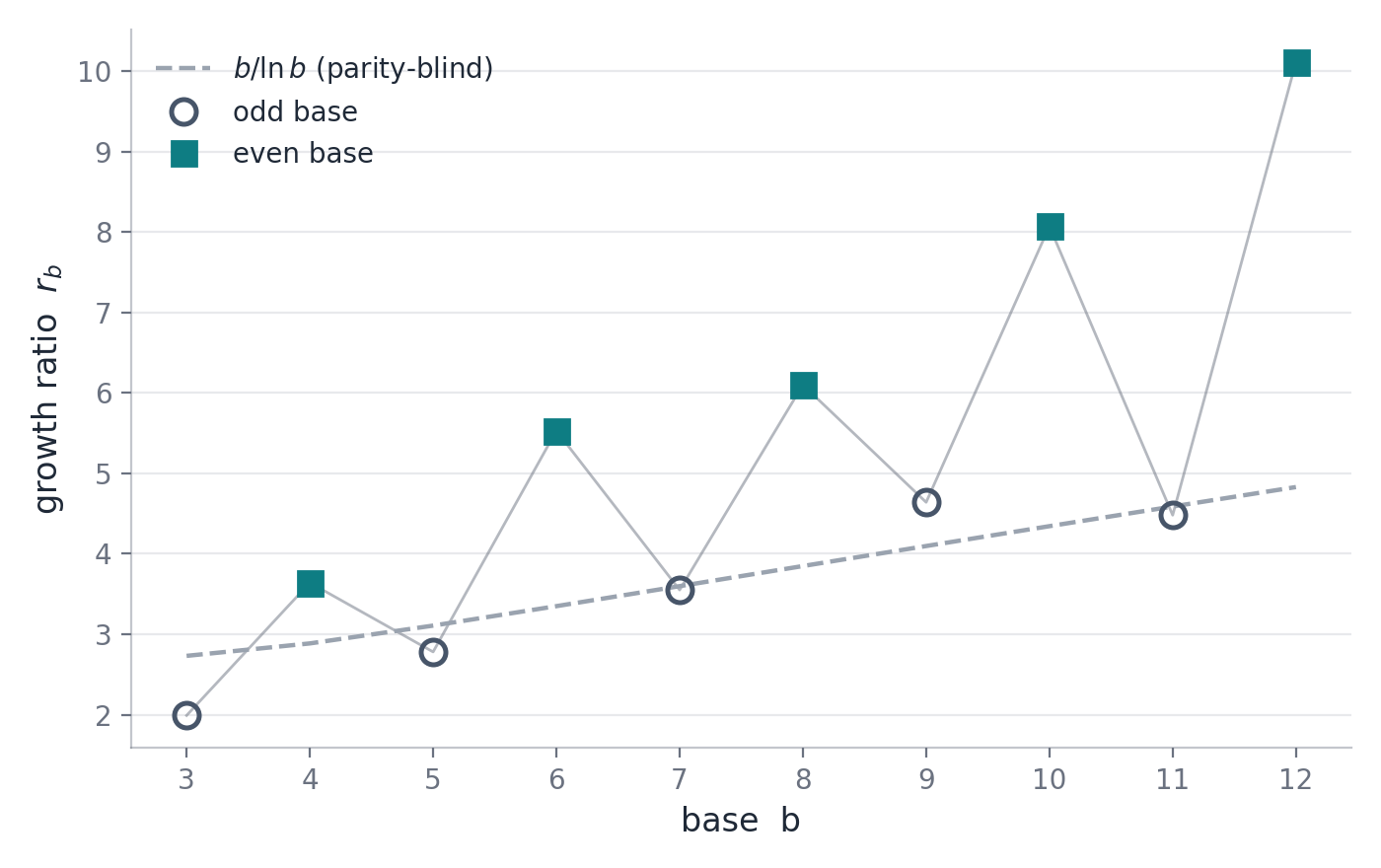
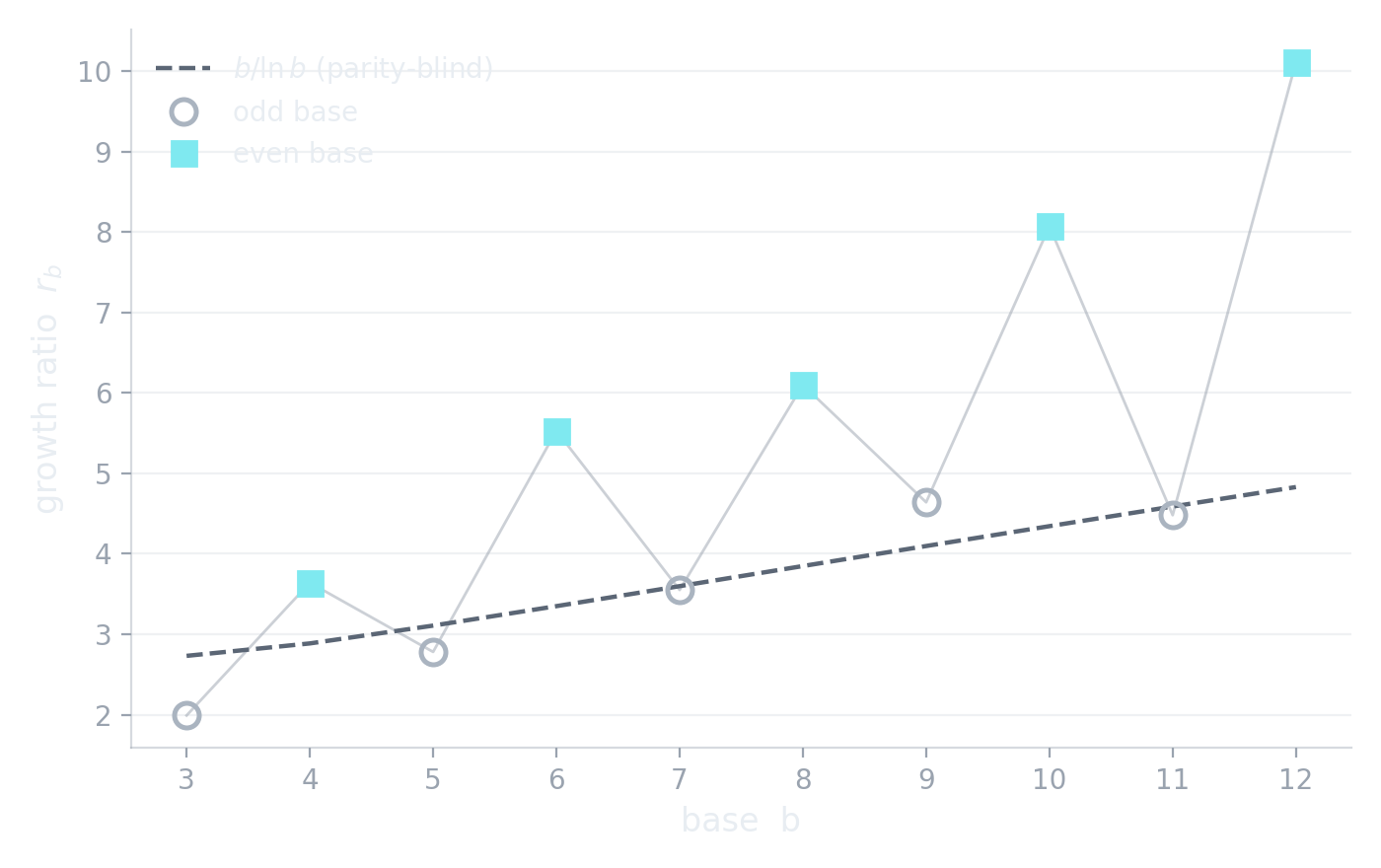
The counts grow geometrically: each digit-length holds a near-constant multiple more deletable primes than the length before it. That multiple, the growth ratio, does not rise smoothly with the base. It zigzags. Every even base grows faster than the odd base just below it. Base 8 multiplies by about 6.1 per added digit against base 7's 3.6; base 10 by 8.1 against base 9's 4.6; base 12 by 10.1 against base 11's 4.5. The even-over-adjacent-odd gap holds across the whole range.
One function explains it
The split has a clean source. The growth ratio factors exactly into two parts: how many new deletable primes each one produces when a digit is inserted, divided by how many deletable parents each new prime descends from. The first part, the offspring count, is set by b2/(φ(b)·ln b), where φ(b) is Euler's totient, the count of values below b that share no factor with it. For an even base, φ(b) is at most b/2: the factor of 2 in the base removes half of those values at a stroke. That one fact is the whole reason for the zigzag. A smaller totient means more offspring per prime, which means faster growth. The even bases even overtake the parity-blind estimate b/ln b drawn on the chart, while the odd bases stay close to it.
Where a chain can end
A second result concerns the finish line: which single-digit prime a deletable number can shrink down to. Two simple rules govern it, one from arithmetic modulo 2 in every odd base, and one from arithmetic modulo 3 in bases that are one more than a multiple of 3 (a pattern noted earlier for base 10 and proved here in general). Both rules were checked against every deletable prime below two million in the bases where they apply, with no exception. The pattern then stops: explicit counterexamples show that no rule of the same kind survives for any modulus 5 or larger.
What entered the public record
The study adds to the open record on three fronts: 37 new terms across the ten count sequences A096236 to A096245; two new sequences, A395332 and A395333, for the smallest and largest base-3 deletable prime at each digit-length; and a full set of source code and verification records. Nothing here is a black box. Every count and every claim can be reproduced.