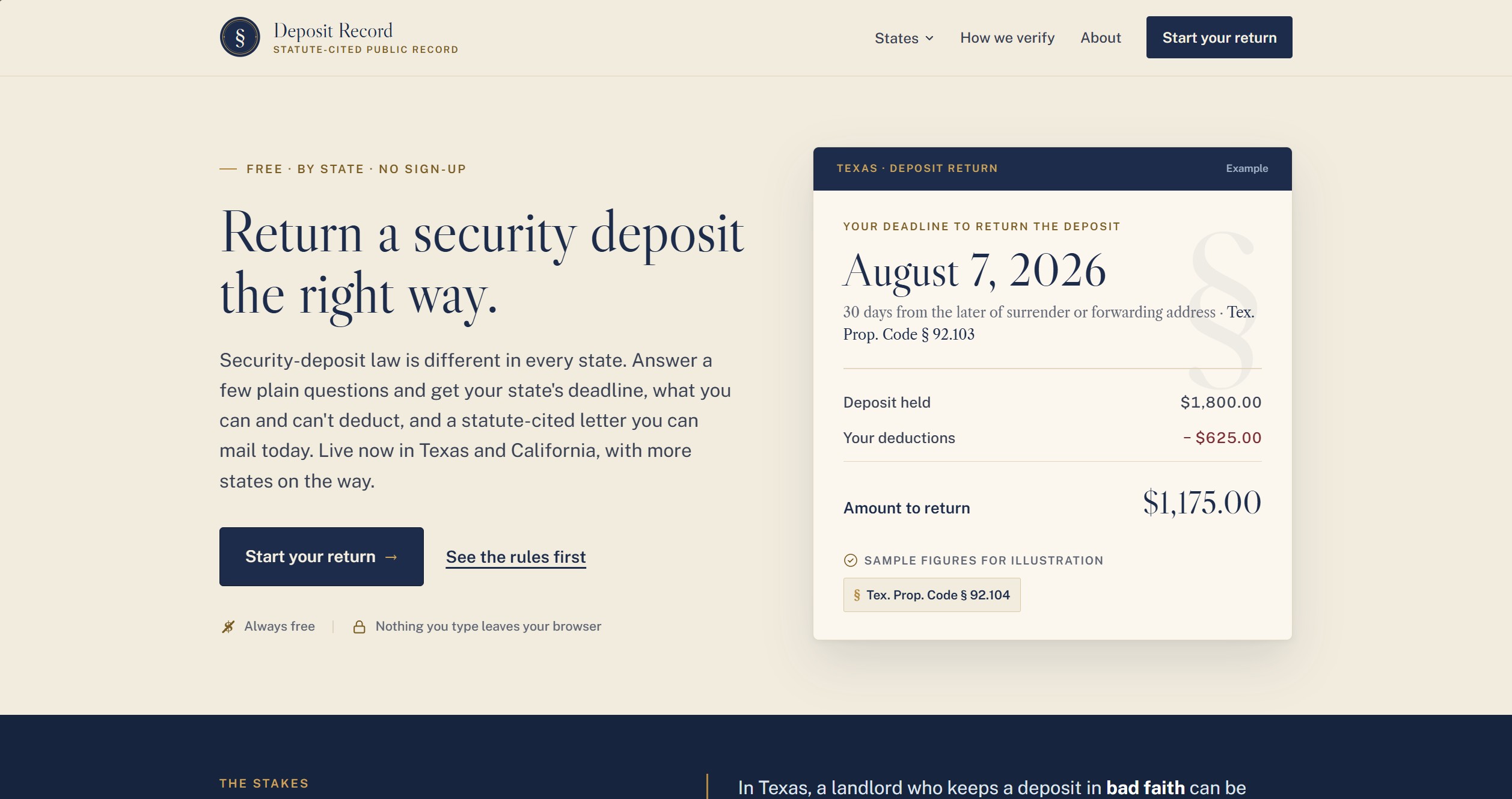
Return a security deposit correctly, with the statute doing the talking.
Deposit Record is a free web tool for small landlords. Enter the vacate date and your
deductions, and it computes the state return deadline, shows what the statute actually says
about every rule it applies, and generates an itemized, editable return letter with
citations. Texas, California, Florida, New York, and Colorado are live. General information, not legal advice.
Enter the vacate date and Deposit Record computes the state return deadline, with the statute section it comes from cited next to the date. Texas allows 30 days under Property Code chapter 92; California allows 21 days under Civil Code section 1950.5. Florida branches under section 83.49 of the Florida Statutes: a 15-day full return, or a notice of intention to impose a claim within 30 days after the tenancy ends when the landlord keeps any of it. New York allows 14 days from the day the tenant vacates under General Obligations Law section 7-108, and the deadline covers both the itemized statement and the return of the balance. Colorado allows 30 days by default under C.R.S. section 38-12-103, a deadline a lease can extend to as much as 60.
Deduction rules, quoted verbatim
What can and cannot be deducted, and where normal wear and tear ends and damage begins. Every rule is quoted verbatim from the statute, with its citation and the date it was last verified against the source.
City deposit interest
San Francisco, Los Angeles, Berkeley, and the City of Boulder require interest on deposits their ordinances cover. Deposit Record computes it from each city's published rates, the California cities' rent-board rate tables and Boulder's municipal interest formula, verified against the cities' own published figures.
An itemized return letter
The tool assembles an itemized return letter from the user's own facts, citations included, editable in the browser before printing. In Florida it generates both documents in sequence: the required notice of intention to impose a claim when any amount is kept, then a return letter for the balance. Each live state also ships a return letter guide; New York adds a dedicated guide to its rent-stabilized deposit rules.
Built like it matters
Legal accuracy is the product.
Every rule in Deposit Record traces to the primary statute and carries its citation and a
last-verified date. The rules were checked against the statute text by independent
adversarial review, and the rendered legal text is pinned byte for byte by snapshot tests,
so it cannot drift silently. Where a legal duty is verified but a current figure is not,
the tool states the duty and shows a blank rather than guessing a number. It is the same
discipline Orygn applies to security tooling, applied to a domain where the reference
implementation is a statute.
AstroTypeScriptCloudflare PagesClient-side onlySnapshot-tested legal text
Privacy
Everything runs in the browser.
Nothing typed into Deposit Record is transmitted, stored, or sold. The math and the letter
are generated client-side, on the user's own device. There are no accounts, no ads, and no
paid tier.
FAQ
Common questions about Deposit Record.
No. Deposit Record provides general information. It quotes the statute with citations and computes dates and amounts from published sources; the user makes every decision. Orygn is not a law firm and no attorney-client relationship is created.
Texas, California, Florida, New York, and Colorado, with more states on the way. Each state ships only after its rules are verified against the primary statute.
No. The math and the letter are generated client-side. Nothing entered into the tool is uploaded, stored, or sold.
Nothing. There are no accounts, no ads, and no paid tier.
Every rule carries the date it was last verified against the statute. The sources behind the rules are monitored for changes, and the pieces that change on a cycle, like city interest rates, are on a scheduled re-verification calendar.
Built by Orygn
Deposit Record is Orygn's engineering discipline on a consumer problem.
Orygn builds custom software, security tooling, and systems where correctness carries real
consequences. Deposit Record demonstrates that on a consumer surface: a domain where the
accuracy bar is a statute, not a style guide.